
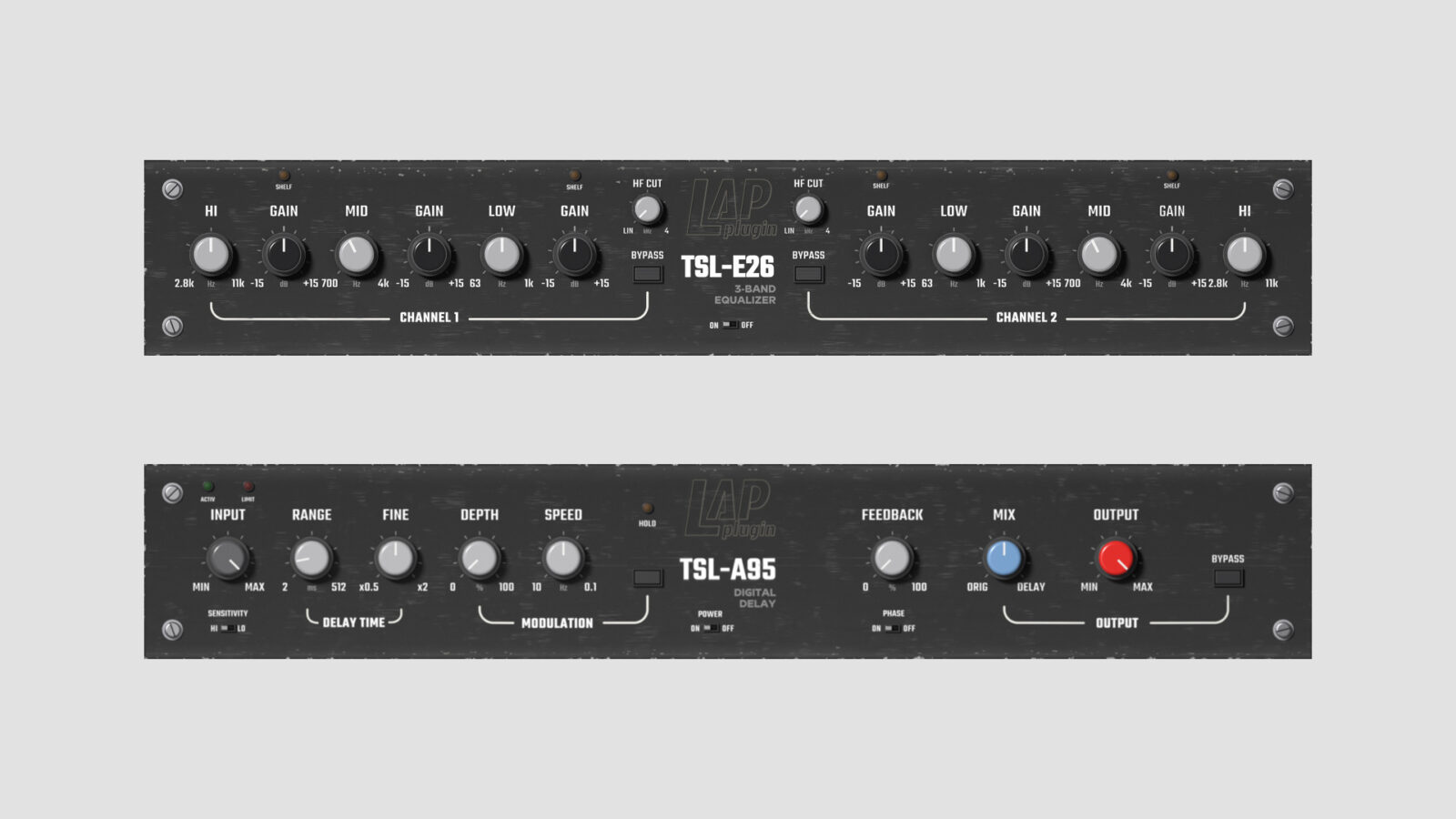
LAP Plugin has two free analog modeling plugins worth a look: TSL-E26, a stepped three-band equalizer, and TSL-A95, a 12-bit digital delay with a modeled analog signal path. Both belong to the developer’s free TSL series and support Windows and Linux.
The connection between the two is their design approach. LAP describes component-level circuit models, including the stages around the main EQ or delay function. As a result, the controls follow the behavior of the modeled hardware rather than a modern processor with every possible adjustment exposed.
Free Analog Modeling Plugins with Distinct Jobs
TSL-E26 offers low, mid, and high bands with stepped frequency choices. Each band provides up to 15 dB of boost or cut in 3 dB steps. There is no separate Q knob; the developer explains that the bell becomes broader as the amount of gain decreases.
For a broad tonal move, that restriction could make the choice easier. You can compare a few deliberate settings instead of working through tiny changes on a continuous control. However, it also means this isn’t the first tool I’d choose for removing one very specific ringing frequency.
The low and high bands can switch to shelving responses. Meanwhile, HF CUT adds a low-pass option for controlling the upper end. Two independent channels can run linked for stereo or separately for dual-mono work.
LAP notes that strong boosts on an already hot signal can clip the modeled output stage. Consequently, leave some level before the EQ rather than assume a clean digital path has unlimited headroom. The optional transformer stage and SATURATION control provide a separate way to explore additional color.
TSL-A95: Delay Time Comes from the Clock
TSL-A95 takes a different route. Its model combines a 12-bit converter and digital memory with an analog path that includes filtering and limiting. RANGE and FINE work together to cover delay times from 1 to 1,024 milliseconds.
The interesting detail is that FINE changes the clock. Moving it while audio remains in the delay line bends the pitch of the repeats. That offers a more animated result than choosing a new delay time and leaving it there.
Feedback and modulation controls let you develop that idea further. There is also a HOLD function, while the mix control sets the balance between the direct and delayed signals. An optional transformer model adds another source of coloration after the main unit.
I’d begin with a short phrase and a modest feedback setting. First, find a useful repeat length; then move FINE and decide whether the pitch movement helps the part. A strongly colored repeat can work well between phrases yet become distracting across an entire busy arrangement.
Formats and Free Downloads
The current product pages list TSL-E26 version 3.4.0 and TSL-A95 version 4.2.7. Both have separate Windows and Linux downloads in CLAP and VST3 formats. There are no Mac builds on these pages.
Each plugin also includes preset management and optional oversampling settings. Use the manual for the details of the modeled controls, especially where a familiar label behaves differently from a typical modern effect.
Download them from the official TSL-E26 page and TSL-A95 page. If you’re looking for a different delay approach, TimeTravel focuses on reverse-delay textures.