
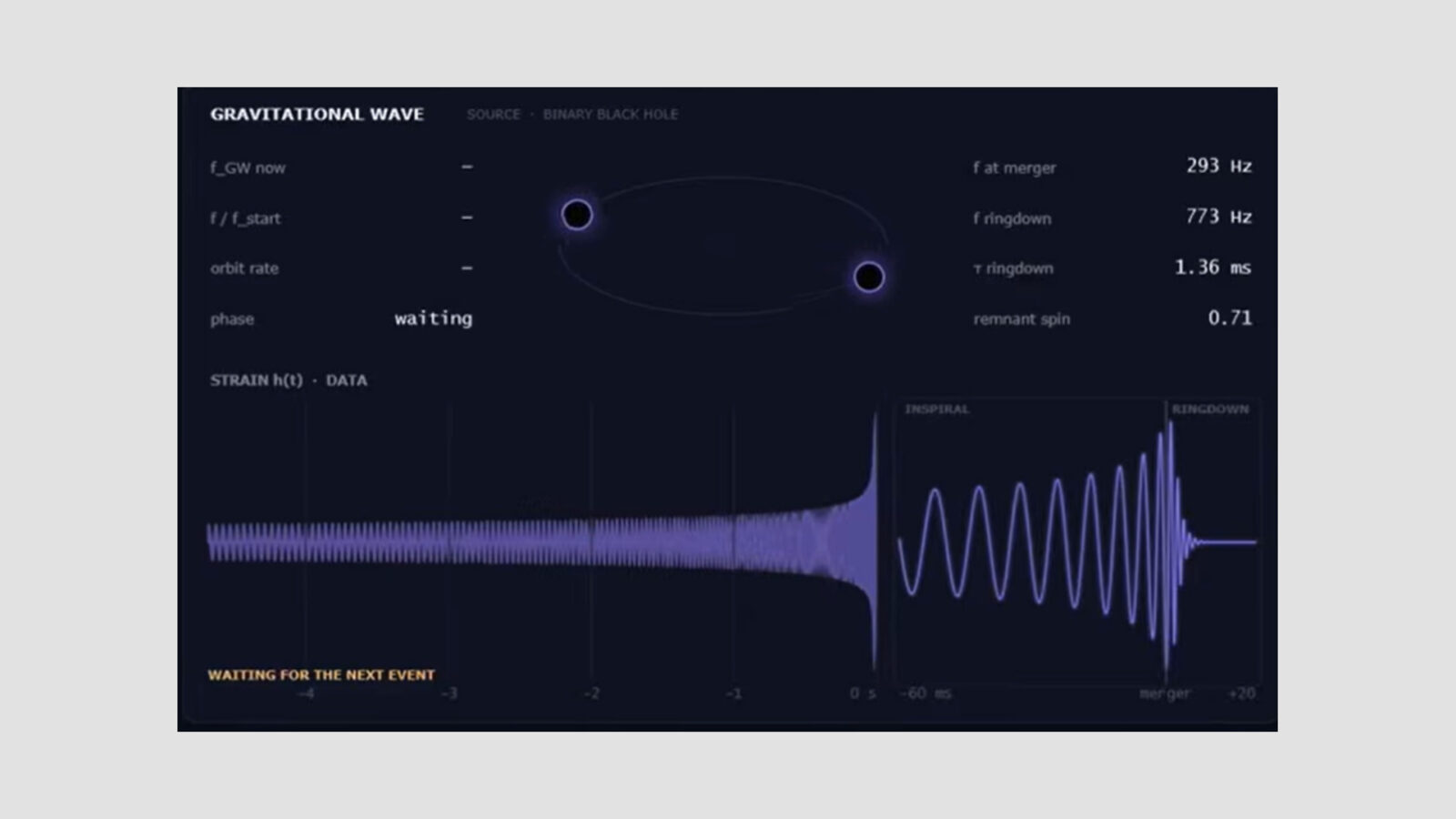
Kael Barba has released CosmicSynth, a free physics synthesizer that uses gravitational-wave models and waveform data to shape playable sounds. The first public version, 0.1.0, runs as a Windows VST3 instrument.
The interesting part is how those ideas translate into notes. A black-hole merger becomes an upward pitch movement. A model of the ringing object left after a merger becomes a bell-like instrument. The synth gives you five starting points, rather than asking you to build the whole system from equations.
Five Instruments Inside This Free Physics Synthesizer
Binary Pad uses the waveform to move a held chord, including a rising merger event. Inspiral Pluck gives each note an upward chirp that reaches its target pitch after 140 milliseconds. That timing is part of the instrument’s behavior, so I’d try it on a sparse melody before writing a tightly quantized lead.
Ringdown Bell turns the post-merger model into pitched overtones. Meanwhile, Kozai-Lidov Triple uses a three-body orbital model to change the tone and pulse. Gravitational Lens adds two versions of a signal with a changing delay between them, moving from interference toward an audible echo.
The controls change relevance with the preset. Inactive ones dim, which should make the panel easier to follow. Depending on the instrument, you can adjust amplitude, pitch, filter, and timbre modulation, alongside the lens and orbital controls.
Start with the Built-In Waveform
You do not need to hunt down research data before playing. CosmicSynth includes a simulated merger waveform. You can also load a compatible CSV file, and the release includes a separate demonstration dataset.
A live spectrogram shows the output as you play. The developer also explains that some behaviors deliberately favor musical results over strict physical accuracy. This is an experimental instrument inspired by the physics, rather than a promise that every sound reproduces an observatory recording.
I’d leave room around its moving notes at first. If you want to extend them into a larger texture, our free reverb plugin guide offers several options for that next stage.
Download the Free Physics Synthesizer
Get the Windows VST3 ZIP from the official GitHub releases page. Extract it and copy the entire cosmicsynth.vst3 folder to your VST3 directory, then rescan in your DAW. The developer tested it in REAPER on Windows; there are no Mac installers in this release.
Developer Demo
The repository links to this demonstration. Its notes mention a later smoothing fix that makes some modulation stronger than the video shows.
CosmicSynth developer demonstration
Loading this video connects to YouTube, which receives your IP address and may use cookies or other storage. Load it only if you agree.